
Rose Miller, financial education consultant with the JN Foundation, leads a presentation during a Smarter Credit Workshop hosted by the JN Financial Academy.

Better Credit, Bigger Possibilities

JN Financial Academy Continues Credit Literacy Push with Fifth Cohort of Smarter Credit Course

As gaps in credit literacy continue to limit access to financing and economic mobility for many Jamaicans, the JN Financial Academy is set to deliver the fifth cohort of its Smarter Credit Course, to help more people position themselves for greater financial stability and opportunity.

The initiative reflects JN’s broader commitment to helping Jamaicans take control of their finances and secure their financial future, particularly at a time when economic pressures are increasingly affecting households.

Rose Miller, financial education consultant with the JN Foundation, which manages the JN Financial Academy, emphasised that poor credit profiles often restrict access to opportunities such as loans, housing, education and, in some cases, even employment. She noted that the course “is designed to equip participants with the knowledge and tools to manage and improve credit, repair bad credit and sustain healthy credit, while reinforcing sound money management practices like saving and budgeting.”

She explained that the fifth iteration of the course will again deliver an impactful and engaging learning experience, with greater interactivity and updated content aligned to current financial realities. It also features the tagline, “Better Credit. Bigger Possibilities.”, reinforcing the direct link between improved financial literacy and access to an expanded range of opportunities.

“We are currently facing rising fuel and grocery prices, and as economic pressures mount, initiatives like this serve not only as educational tools but as practical interventions that can help people better adjust and manage their obligations while reducing financial stress,” Mrs Miller said.

The course combines flexible learning with structured engagement, featuring four self-paced online modules supported by quizzes and three live webinars where participants can interact directly with subject matter experts. The webinar sessions, scheduled for 6:30 p.m. on June 3, June 17 and July 1, will provide opportunities for participants to ask questions, explore case studies and gain deeper insight into areas covering credit reports and debt management strategies.

Mrs Miller said the course also remains accessible, with no associated fees to participants, removing a key barrier to entry and enabling everyone to benefit from the training. This accessibility, she noted, is central to the academy’s goal of expanding financial knowledge across a wider cross-section of the population.

“Across the previous four cohorts, participants have demonstrated real transformation in how they approach credit, translating knowledge into meaningful financial progress. We are looking to expand that impact in this next cohort,” she said.

Beyond individual benefits, the initiative is also expected to have positive implications for the wider economy. Mrs Miller reiterated that improving credit literacy supports greater participation in the formal financial system.

She added that as more people become financially aware, they are better positioned to access and manage credit responsibly, which contributes to the stability and growth of the financial sector.

“Many individuals remain underserved or excluded from the formal financial system due to poor credit histories or limited understanding of how credit works,” Mrs Miller said. “Expanding credit literacy helps more people to engage in responsible borrowing and reduces risks. This will enable our people and the Jamaican economy to become even more resilient.”

Registration for the Smarter Credit Course is now open via the JN Financial Academy’s website at https://jnfinancialacademy.com. Interested individuals must complete the online registration form on the platform and follow the instructions provided to finalise enrollment. Participants will receive a certificate of completion upon successfully finishing the course.


Read more

Navigating Rising Costs: Practical Financial Tips for Today’s Households

With prices climbing, from groceries to fuel, many households are feeling the strain. Inflation, higher interest rates and general economic uncertainty have made every day budgeting more challenging than ever.

Rose Miller, financial education consultant with the JN Foundation, says the key to managing this period isn’t panicking; it’s planning.

“People can’t control inflation, interest rates or the price of fuel,” Mrs Miller says. “But what they can control is how they manage their financial resources to ensure they remain afloat.”

Her advice focuses on simple, practical steps that can help consumers reduce stress and stay financially grounded, even as economic pressure mounts.

Instead of worrying, she is encouraging households to redirect their energy towards what they can control, such as how they spend, borrow and save. Making intentional choices about these behaviours can have a meaningful impact on overall financial health.

Get Everyone on the Same Page

For households, communication is critical, she noted, “If you’re in a household, you need to have a conversation and get everyone aligned,” Mrs Miller says.  “And this is true whether there is a single or multiple incomes, but especially so for single income households.

“Everyone has to be on the same page about how money is being spent and the plan to get through this period.”

Without frank and honest discussions about the family’s finances, frustration and conflict can quickly arise, as a result of misaligned goals, behaviours and expectations, she added.

It’s Time to Revisit the Budget

“If budgeting has fallen by the wayside, now is the time to bring it back. We’re going back to the budget, and this time, we have to be very intentional,” Mrs Miller says.

That means closely examining daily spending habits, being more conscious about purchases, and paying attention to where and how money is being spent. Shopping smarter, exploring alternatives, and cutting back on non-essentials can help stretch household income further.

“Think about what you buy, where you shop, and whether there’s a more affordable option,” she advises.

And with interest rates likely to rise, Mrs Miller recommends exercising caution when it comes to new borrowing, especially for large purchases.

“This is not the time to rush into major loans if you can avoid it,” she says. “Higher interest rates mean higher monthly payments, and more pressure on the budget.”

For those already struggling under the weight of existing debt, however, there may be relief options worth considering. Mrs Miller points to debt consolidation as one possible strategy.

“If debt is already strangling your finances, consolidating could provide a lifeline,” she explains. “By extending the repayment period, you would be able to reduce your monthly payments and create some breathing room.”

Mrs Miller emphasises that financial stress doesn’t just come from money, but oftentimes from uncertainty.

“This is going to be a trying time for many people,” she says. “But with careful planning, you can reduce stress and put yourself in a better position to cope.”

Small steps taken now, adjusting spending, talking openly about finances, and managing debt responsibly can make a significant difference to our outcome.

“The goal isn’t perfection,” Mrs Miller adds. “It’s survival and stability. And with the right approach, households can navigate this period of economic uncertainty with greater confidence.”

Read more

Mustard Seed to Undertake Critical Repairs with Funds Raised by JN

Photo Caption: Members of the JN Foundation, St John Ambulance team and Mustard Seed Communities take a group photo.

The JN Foundation has channelled approximately $1.4 million to the Mustard Seed Communities’ (MSC) Blessed Assurance home in St James to assist with critical rebuilding following severe damage by Hurricane Melissa.

The funds were allocated from monies raised through the ISupportJamaica Fund, activated by the JN Foundation as Hurricane Melissa made landfall in Jamaica. The Fund received contributions mainly from Jamaicans overseas and friends of Jamaica.

Blessed Assurance, which houses adults and children with physical and developmental challenges, is still recovering from severe flooding that displaced residents, destroyed or severely damaged infrastructure and assets, including cottages, utilities, and essential equipment.

Reverend Father Garvin Augustine, executive director of Mustard Seed Communities, said the facility was among MSC’s hardest hit, with floodwaters rising to roof level in some areas, forcing staff to evacuate residents, many of whom are children, to upper floors for safety.

“All the cottages were flooded, bedding and furniture were destroyed, and there was no access to the property for days because the road was completely washed away,” he explained. “But through the generosity of our partners and the wider community, we have been able to begin the long and difficult process of rebuilding.”

Thirty per cent of cash donations to the ISupportJamaica Fund have been earmarked to repair severely affected facilities for the vulnerable and/or at risk like Blessed Assurance, while 40 per cent will support early childhood institutions and the remaining 30 per cent will be channelled to first responders and community groups actively involved in the recovery process.

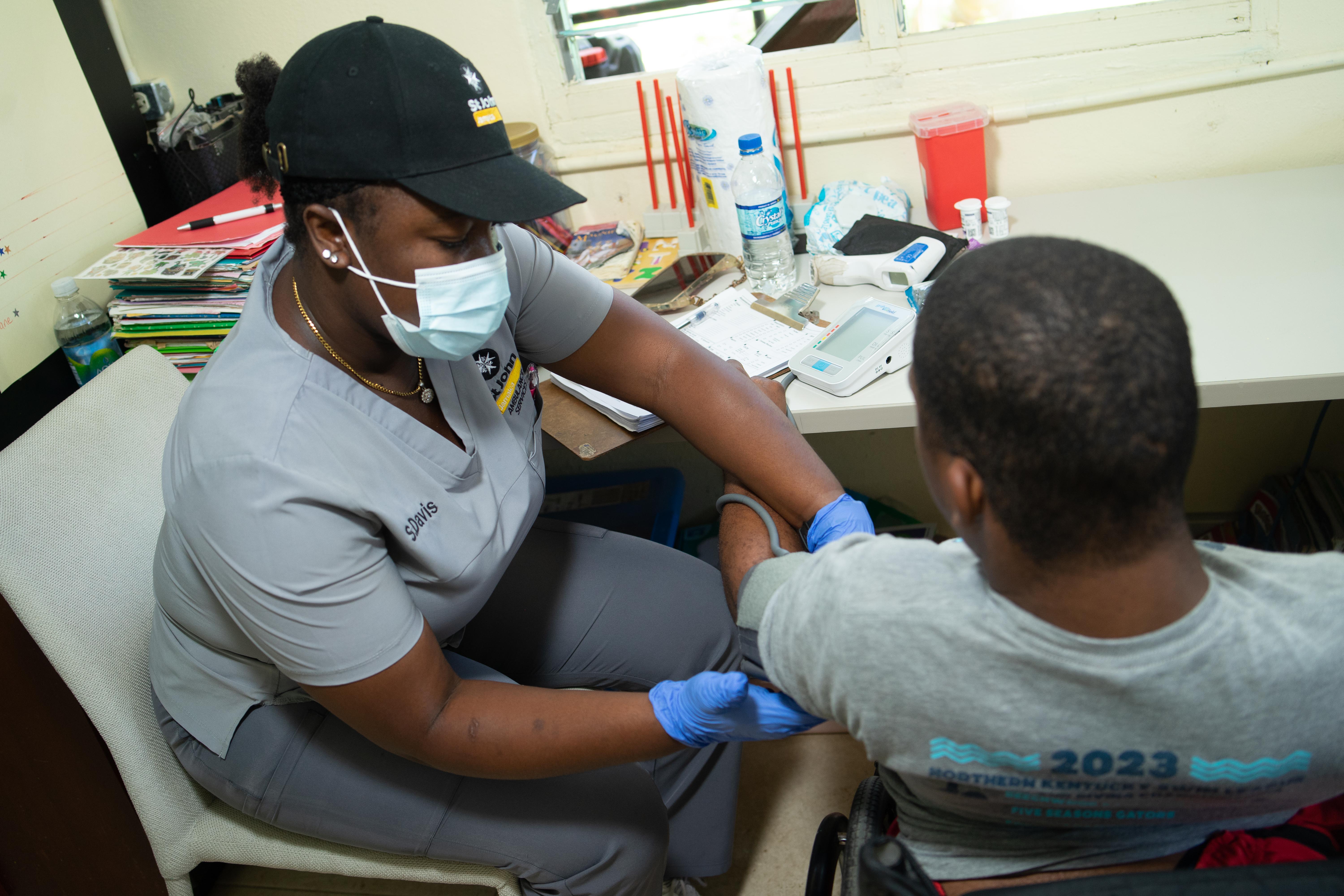
Photo Caption: Shannon Davis (left), emergency medical technicians at St John Ambulance takes the vitals of residents of Blessed Assurance.

“Mustard Seed Communities makes for a worthy beneficiary, as the organisation is strong on mission credibility, operational competence and institutional trust. Over the years, we have collaborated to help to bring relief to its residents, most of whom are the most vulnerable in our society,” Omar Wright, lead, Environment and Community Development at the JN Foundation, said.

In addition to the financial contribution, the JN Foundation collaborated with St John Ambulance Jamaica to provide much-needed health services to residents and members of staff. The outreach forms part of a wider series of medical missions funded by Corus International, an ensemble of faith-based organisations. Since the passage of the hurricane 17 missions have been led to date by the JN Foundation across rural and underserved communities.

Mr Wright said the medical outreach was launched to address persistent gaps in access to care post Melissa.

“The primary objective is to reach vulnerable communities, particularly the elderly and persons living with disabilities, who may not have seen emergency services or relief since the hurricane,” noted Mr Wright. “At Blessed Assurance, the mission was especially impactful because of the complex medical needs of the children and the caregivers.”

He explained that the programme targets underserved and hard‑to‑reach communities, particularly in the western parishes.

He noted that the initiative aims to reach up to 1,200 residents by the end of the programme. The medical team, which included doctors, nurses, emergency medical technicians, and ambulances supplied by St John Ambulance, conducted basic medical screenings, including blood pressure and blood sugar tests, and pre-hospital assessments. Prescription refills and limited on-site medication dispensing were also provided.

Photo Caption: Omar Wright (left), lead, Environment and Community Development at the JN Foundation presents a cheque to Reverend Father Garvin Augustine, executive director of Mustard Seed Communities to carry out repairs to Blessed Assurance in St James, which was damaged by Hurricane Mellisa last year. The presentation was made recently at the mission.

The members of staff welcomed the medical mission, noting that access to care is often delayed or avoided, even though stress and anxiety levels have remained high in the aftermath of the hurricane.

Alecia Bowyer, administrative assistant at the mission, commended the services offered by the medical mission. “I received excellent service; the medical team was helpful and attentive. They have reminded me of the importance of taking better care of my health and how I can improve my diet,” she said.

Meanwhile, Karen Miller Bogle, a family nurse practitioner with the St John’s Ambulance team, reflected on the experience, noting the importance of gratitude and collective action.

“In everything, give thanks. Sometimes you may feel that your situation is very difficult, but when you participate in these outreaches, you realise that others are facing far greater challenges and are still doing their best to survive. It underscores how important it is for people to come together and work as a team, as this ultimately benefits the entire community,” she said.

Read more